
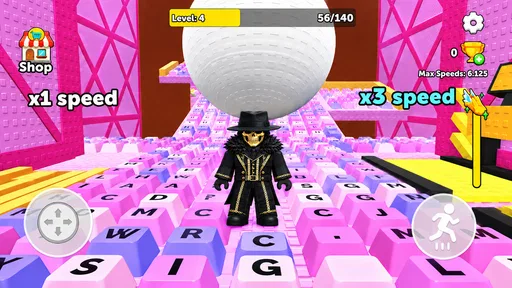
Keyboard Escape: +1 Speed ASMR review
 Analysis by GetAllApps
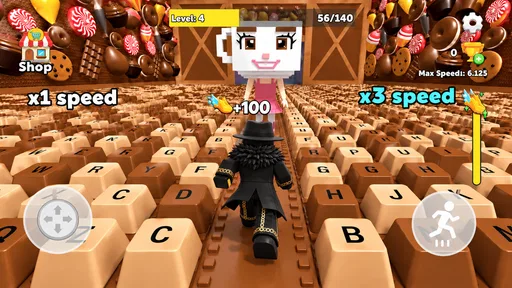
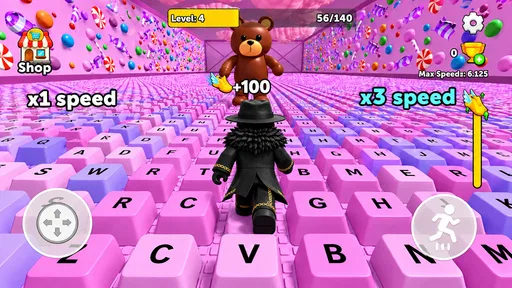
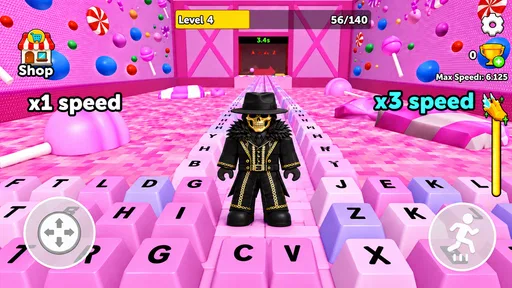
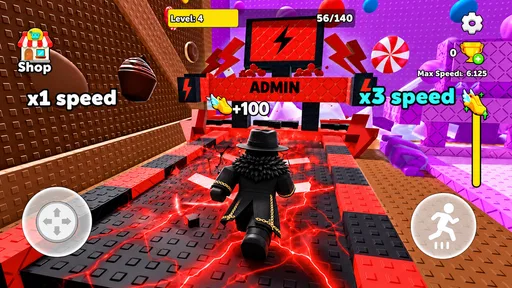
Keyboard Escape: +1 Speed ASMR is a small, focused simulation game built around a simple loop: move through an escape challenge, avoid obstacles, and build speed as you go. I found its appeal less in having a deep world to explore and more in the rhythm of repeating a run, reacting to what is in front of me, and enjoying the keyboard-themed sound and feel. It suits short breaks when I want something immediate, though it is not the game I would choose for a long, story-driven session.
Getting into a run and finding your rhythm
The first thing I would recommend is treating each attempt as a chance to learn the pace rather than as a race to finish. The premise is easy to understand, but a run can still feel hurried when movement and dodging have to happen together. I got more consistent by watching the path ahead and making deliberate corrections instead of reacting to every obstacle at the last moment.
The speed increase gives the loop a clear source of pressure: progress also makes the next decisions more demanding. That is a satisfying trade-off when I am in the mood to focus, but it means rushing is not always the smartest approach. A steadier run can be more rewarding than chasing speed immediately, especially while I am still learning how the obstacles are arranged and how much room I have to respond.
The keyboard-inspired presentation gives the game a distinct identity, and the ASMR angle makes the experience feel more tactile than a bare obstacle course. I would keep the volume at a level that lets the sound remain pleasant rather than distracting, particularly if I am playing in a quiet room. The audio is part of the mood, but the visual path still deserves most of my attention when the pace picks up.
For an everyday use case, I can see myself opening it while waiting for a bus or taking a short break between tasks. A run gives me something active to do without asking me to remember a plot, manage a complicated setup, or commit to a long session. If I have only a few minutes, I can focus on one attempt and stop; if I have longer, repeating runs gives me a simple way to work on timing.
Make the controls and sound comfortable first
Before trying to improve, I would check the options the game actually presents and adjust only what is available. In a quick-reaction game, comfortable audio and a screen position that feels easy to watch can matter more than chasing an ideal configuration. I would not assume that a particular control layout, sensitivity slider, or shortcut exists; the useful habit is to learn the real controls shown in the game and make them feel familiar.
That restraint also helps distinguish a genuine settings benefit from wishful thinking. If the game offers a sound adjustment, I would choose a level that preserves the keyboard-like texture without making it hard to concentrate. If no adjustment is offered, lowering the device volume is a straightforward alternative. Either way, I would avoid changing several things between attempts, because then it becomes harder to tell whether a better run came from improved timing or a different setup.
I also find it useful to settle on a repeatable way to hold the device and interact before a session. Small changes in grip can make quick corrections feel awkward, especially when I am playing one-handed. A stable posture and a clear view of the route are simple, practical advantages; they do not require an advanced feature, but they reduce avoidable fumbling when the action speeds up.
Build faster habits without fighting the game
Once the basic movement feels comfortable, I would focus on a repeatable cycle: scan a little ahead, make the necessary dodge, then return attention to the next opening. This is more useful than staring at the character alone, because the challenge is about anticipating what is coming rather than merely responding to what has already reached me. It also gives my eyes a consistent job, which makes the increasing pace feel less chaotic.
A second helpful habit is to treat speed as a consequence of a clean run, not as the only goal. The game’s speed-building premise can tempt me to push aggressively, but a poorly timed move can undo the advantage of going faster. When I notice myself making hurried corrections, I reset my attention to safe movement first. That small change helps me enjoy the escalation instead of turning every attempt into a frantic chase.
I would also compare runs by one clear observation at a time. For example, I might notice whether I am missing openings because I react late, or because I am looking too close to the character. I would not invent a score system or assume that the game tracks these details; the point is simply to give each attempt a purpose. Repeating the same approach for a few runs makes it easier to recognize whether my timing is improving.
There is a useful stopping point, too. If I begin making the same careless mistake because I am tired or distracted, another attempt may add little. Taking a short pause and returning with a fresh view can be better than tapping through runs on autopilot. That is especially true for a game whose appeal depends on responsive movement and satisfying feedback: when I stop paying attention, the central loop loses much of its charm.
Where the quick-loop design has limits
This is a narrow kind of simulation game, and that focus is both its strength and its limitation. It gives me a clear action to practice, but it is not a substitute for a management simulation, a realistic keyboard tool, or a game with layered objectives and a substantial campaign. Players who want collecting, crafting, a long progression system, or a detailed narrative should look elsewhere rather than expecting those elements from a compact dodge-and-speed concept.
The pace can also be a poor fit for someone who dislikes escalating pressure. The speed mechanic makes success feel lively, but it can turn a relaxed session into a test of quick reactions. If I want something calm enough to play while barely looking at the screen, this is not my pick. The keyboard-themed sound may be enjoyable, yet it does not remove the need to watch the route and respond carefully.
Compared with typical simulation games that ask me to plan resources or maintain a virtual routine, this one is more immediate and reflex-led. Compared with a conventional endless runner, its keyboard identity and ASMR framing are the more distinctive parts of the pitch, while the basic appeal remains short, repeatable movement challenges. That makes it a better choice for quick bursts than for someone seeking a broad catalogue of activities in one app.
It is free to play, and its Everyone age rating makes it broadly accessible. The game is developed by Goldoint, and its current version is 0.1.1. It has a 3.4 average from around 3,400 ratings, while the review count is 27; those figures suggest a mixed reception rather than a unanimous recommendation. I would treat that rating as one signal, then decide based on whether a simple, speed-building obstacle loop is actually the kind of play I enjoy.
Who should try it, and who should pass
I would recommend Keyboard Escape: +1 Speed ASMR to players who like short reaction challenges, enjoy a focused sound design, and are happy to improve through repetition. It can work well as a small between-tasks game because the central idea is easy to grasp and does not demand a large time commitment. The most satisfying sessions are the ones where I settle into a rhythm and make cleaner decisions, not the ones where I try to force every run to be faster.
I would skip it if I am looking for a deep simulation, extensive customization, or a relaxed experience with no pressure to react. I would also choose a different game if I want more varied goals than navigating and dodging while speed rises. Those are not faults so much as limits of the concept; knowing them in advance makes it easier to judge the game on what it is actually trying to do.
On Android, the stated minimum operating system is version 8.1, so I would check that my device meets that requirement before trying to install it. The game has passed five million installs, which shows that the simple premise has found an audience, but popularity alone does not mean its particular rhythm will suit everyone. I would try a few focused runs, learn the available controls, and see whether the sound and pace feel satisfying on my own device.
A modest game that rewards deliberate play
My verdict is that Keyboard Escape: +1 Speed ASMR works best as a compact reflex game with a recognizable keyboard theme. Its strongest quality is the straightforward loop: watch, dodge, build speed, and try again with better timing. The best way to get more from it is not to hunt for imaginary shortcuts or hidden systems, but to keep the setup comfortable, pay attention to the path ahead, and make each repeat attempt a little more deliberate.
That approach will not turn it into a deep or varied game, and anyone who wants a broader simulation should choose something else. But for a free, quick session that asks for focus without a long commitment, it has a clear place. I would keep it in mind for short breaks, especially if the keyboard-themed audio appeals to me, while going in with realistic expectations about the narrow scope and reaction-heavy pace.
Pros and cons
Pros
- Quick rounds make it easy to play during short breaks.
- Simple controls are approachable for new players.
- Increasing speed adds a clear sense of challenge.
- ASMR-style sounds give actions satisfying feedback.
- The game rewards quick reactions and careful timing.
Cons
- Rising speed can make later stages difficult to follow.
- Repeated gameplay may feel predictable over time.
- Fast play may be frustrating for younger or casual players.
- Sound effects may become repetitive during long sessions.
- The focus on speed leaves little room for varied strategies.


